Hardwood flooring. It brings a level of character and charm to any room that’s hard to beat, enhancing a home with a welcoming warmth that other aesthetics just can’t match. In most homes, the kitchen is the social gathering spot, and the place where you’d most want to feature that warm, welcoming vibe. As a result, we’re often asked about the best type of hardwood flooring for kitchens.
Unfortunately, this turns out to be something of a trick question. Because of the constant risk of splashes from the sink or wet food spills, which can damage wood floors, genuine hardwood is not recommended for kitchen flooring. But that doesn’t mean you have to forgo your style dreams in pursuit of practicality. Today’s high-quality wood-look flooring means you can get all the character of the real material without the associated risks. Let’s look at the three main ways you can still enjoy the vibe of hardwood in your kitchen.
Luxury Vinyl Plank Flooring is an Ideal Choice for Kitchens
.jpg?language=en "Kitchen - Vinyl")
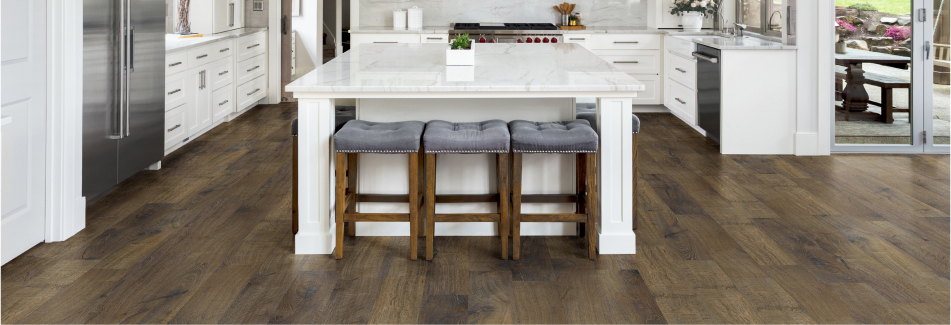
One of the most practical ways to achieve the aesthetic of hardwood floors in your kitchen is with luxury vinyl plank (LVP) flooring. This man-made material can be crafted to match a nearly endless range of designs, mimicking hardwood and other materials. It’s prized for its high durability, water-resistant or fully waterproof construction, and overall ease of maintenance. This combination of features makes it an ideal choice for any area of the home that sees heavy foot traffic and is likely to be exposed to spills and splashes, just like your kitchen.
Most LVP styles are also significantly more affordable than real wood flooring, helping overcome another common friction point with hardwood floors.
Luxury vinyl plank’s convenience, versatility, and convincing mimicry of solid hardwood have made it the most popular hard-surface flooring on the market today. But LVP is not without its drawbacks. Some homeowners who are after the true character of genuine hardwood find that luxury vinyl plank just doesn’t “feel” enough like real wood, or they can tell at a quick glance that it’s a substitute material because of the repeated plank patterns found across the floor of a single room.
These valid criticisms are among the reasons Empire Today® started offering our exclusive DuraVista line of premium LVP. It features an ultra-realistic, embossed wood surface that delivers a more convincing real-wood look and feel. Plus, it has a board variation level up to 5x that of most typical LVP products, meaning you’ll see significantly fewer repeated planks per room.
Laminate Floors in the Kitchen: All of Vinyl’s Convenience with More Character
.jpg?language=en "Kitchen - Laminate")
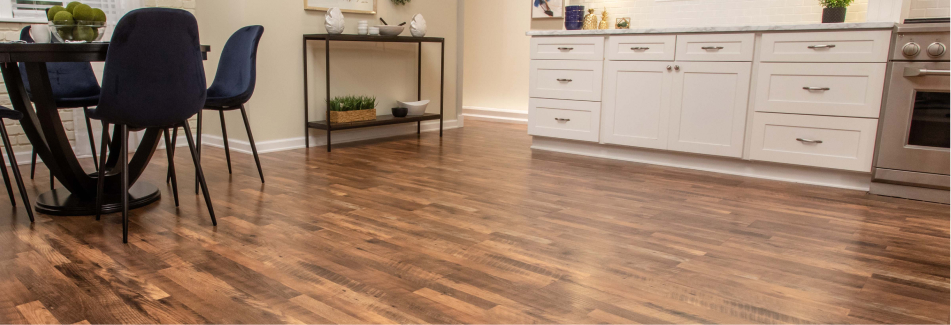
Wood laminate flooring offers many of the same benefits as LVP but often receives higher marks from homeowners seeking a more realistic hardwood alternative. This is because laminate flooring is made in part with real wood. Now, you won’t find any solid hardwood layers or a real wood veneer on laminate flooring. Instead, it’s constructed in a manner similar to many modern pieces of furniture. At its heart is a dense, durable fiberboard or plywood core, bonded to a top layer featuring a printed wood image. A wood-grain texture is embossed on that surface, matching the printed image and creating a seamless wood look and feel. And on top of that is a protective wear layer that helps it resist surface damage.
Since laminate flooring is made in part from wood, it tends to feel and sound a bit more like genuine hardwood. For those chasing the inherent character that solid hardwood floors bring to a space, laminate flooring has a slight edge over LVP while still having many of the same benefits. Laminate can be constructed with a highly scratch- and stain-resistant top layer, and many styles are also fully waterproof.
And for those looking for an uncompromising option, the Empire® Everwood premium wood laminate flooring offers the ultimate in both form and function. Everwood laminate flooring is built with the highest wear rating in the industry, fully waterproof⁂ construction, and twice the plank visuals of typical laminate floor for a more authentic wood look.
Engineered Hardwood Flooring for Kitchens: High Style but Still Some Risks
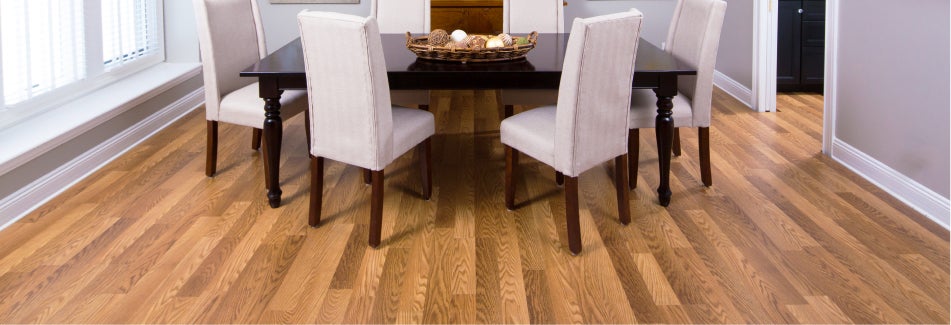
Engineered hardwood flooring presents the best option for homeowners who insist on floors that are as close to real wood as possible and suitable for use in the kitchen, but who don’t demand all the protections that manmade materials offer. Made by fusing a dense synthetic core with a top layer of solid wood, engineered hardwood was created to offer a “best of both worlds” option. The highly stable core and factory-applied protective topcoat offer enhanced resistance to denting, as well as the warping or cupping that moisture can cause in solid hardwood floors. While not technically water-resistant, engineered hardwood is better suited than solid hardwood flooring for use in damp environments and areas that might see occasional splashes or spills.
But because the top layer is crafted from real wood, the floors still look and feel exactly like solid hardwood flooring. Every plank of engineered flooring will be unique from the next, since the surface is a layer of genuine wood. This also means that engineered hardwood can even be sanded and refinished like the real thing.
In the end, each of these options presents a compelling alternative to installing hardwood flooring in a kitchen:.
- Luxury vinyl plank is typically the top choice when convenience and durability are paramount
- Engineered hardwood is ideal if you’re primarily after the genuine hardwood character and don’t need all of the protections of a manmade material
- Wood laminate splits the difference as a great combination of real-wood character ease of maintenance.
So, if you’re shopping for new kitchen floors and have your heart set on the character of hardwood, the wide variety of wood-look flooring options means you can have your cake and eat it still. And then you can drop that cake on the floor and wet-mop it up without worrying about damaging the flooring underneath.